Keep Rethinking Sunscreen: Protection Is Only Half the Story.

Rethinking Sunscreen: Protection Is Only Half the Story
Sunscreen is one of the most important tools we have for protecting skin from premature photoaging.
But modern sun care is increasingly about more than applying an SPF product before going outside.
Ultraviolet exposure can trigger a cascade of biological effects within skin, including oxidative stress, inflammatory signalling, disruption of barrier function and damage to cellular structures.
That suggests a broader approach to sun care:
Protect before exposure → support antioxidant defence during exposure → help the skin recover afterwards.
Sunscreen remains the foundation.
But it can be part of a more complete strategy.
What UV Radiation Does to Skin
Sunlight reaching the skin contains several wavelengths, but UVA and UVB radiation are particularly important in skin biology.
UVB is strongly associated with sunburn and direct DNA damage.
UVA penetrates more deeply into the skin and contributes substantially to photoaging and oxidative stress.
Repeated exposure can influence:
-
collagen and elastin
-
pigmentation
-
cellular DNA
-
membrane lipids
-
antioxidant systems
-
inflammatory pathways
-
barrier function
Over time, these processes contribute to many of the visible signs we associate with photoaged skin.
These can include:
-
uneven pigmentation
-
loss of firmness
-
fine lines
-
rougher texture
-
reduced elasticity
-
uneven tone
This is why effective UV protection is fundamental to any serious long-term skin-aging strategy.
Sunscreen Is the First Line of Defence
A properly formulated broad-spectrum sunscreen reduces the amount of damaging ultraviolet radiation reaching the skin.
That is its essential role.
No antioxidant mist, serum or post-sun product should be regarded as a substitute for sunscreen.
A sound photoprotection strategy still begins with:
-
appropriate broad-spectrum sunscreen
-
adequate application
-
reapplication when required
-
protective clothing
-
shade
-
sensible avoidance of excessive UV exposure
These measures reduce the initial biological insult.
But even with good sunscreen use, complete elimination of UV exposure is unrealistic.
This is where complementary skincare becomes interesting.
UV Exposure and Oxidative Stress
One important consequence of ultraviolet exposure is increased production of reactive oxygen species, or ROS.
These reactive molecules can interact with:
-
proteins
-
lipids
-
cellular membranes
-
extracellular matrix components
-
signalling pathways
Under normal conditions, skin possesses antioxidant systems that help control reactive oxygen species.
But excessive environmental stress can overwhelm those defences.
The result is oxidative stress.
This creates an important link between sun care and antioxidant skincare.
Sunscreen aims primarily to reduce the amount of UV radiation initiating the process.
Antioxidants can complement that strategy by supporting the skin's ability to manage oxidative pressure.
Why Antioxidants Are Relevant to Sun Care
Several cosmetic antioxidants are particularly interesting in the context of environmentally stressed skin.
Vitamin C
Vitamin C contributes to antioxidant defence and is also involved in collagen-related biology.
Vitamin E and Tocotrienols
Vitamin E compounds are lipid-compatible antioxidants that are particularly relevant to lipid environments and cellular membranes.
Coenzyme Q10
Coenzyme Q10 has a dual role.
It participates in mitochondrial energy metabolism while also functioning as an antioxidant.
This makes it especially relevant where oxidative stress and cellular energy intersect.
Polyphenols
Plant-derived compounds such as green-tea polyphenols, ferulic acid, quercetin and resveratrol are widely studied for antioxidant and cellular-signalling properties.
The important concept is not that one antioxidant “blocks the sun.”
It does not.
Rather, complementary antioxidant systems can form part of a broader strategy for helping skin manage environmental oxidative stress.
Sunscreen and Antioxidants Perform Different Jobs
This distinction is essential.
Sunscreen reduces exposure.
Antioxidants support defence against oxidative processes.
They are complementary rather than interchangeable.
A useful way of viewing modern sun care is:
UV filtration + Antioxidant defence + Barrier support
Each addresses a different aspect of the problem.
What Happens After Sun Exposure?
Skin biology does not instantly return to baseline the moment a person steps indoors.
UV exposure can initiate cellular and inflammatory responses that continue after direct exposure has ended.
This does not mean that an after-sun cosmetic can reverse all UV-induced damage.
It cannot.
But post-exposure skincare can reasonably focus on supporting the environment in which recovery processes occur.
Useful objectives include:
-
cooling and soothing
-
hydration
-
barrier support
-
antioxidant support
-
reducing unnecessary irritation
-
maintaining skin comfort
This is a much more scientifically defensible interpretation of “after-sun repair.”
The objective is to support recovery, not claim to erase UV injury.
Why Barrier Support Matters After Exposure
UV exposure can also affect skin-barrier function.
A stressed barrier may lose water more readily, contributing to:
-
dryness
-
tightness
-
discomfort
-
reduced flexibility
After-sun care should therefore not focus on antioxidants alone.
Hydration and barrier-support ingredients can also play important roles.
Examples include:
-
betaine
-
panthenol
-
sodium PCA
-
sodium lactate
-
ectoine
-
aloe-derived ingredients
-
suitable humectants
-
lightweight emollients
This gives us a broader recovery model:
Antioxidant support + Hydration + Barrier comfort
The Role of Cellular Energy
Skin recovery is an active biological process.
Cells require energy for:
-
protein synthesis
-
membrane maintenance
-
signalling
-
antioxidant defence
-
cellular housekeeping
-
repair processes
That connects sun stress with the emerging field of bioenergetic skincare.
Mitochondria are directly involved in cellular energy production and are themselves influenced by oxidative stress.
This creates an important relationship:
UV stress → oxidative pressure → increased biological workload → energy-dependent recovery processes
Ingredients associated with mitochondrial and cellular-energy pathways therefore become interesting within broader longevity-oriented skincare.
This includes ingredients such as:
-
Coenzyme Q10
-
creatine
-
adenosine
-
niacinamide
Again, this should not be interpreted as claiming that a cosmetic can reverse UV-induced DNA damage.
Rather, these ingredients fit within a strategy designed to support the normal biological environment associated with cellular resilience.
Why Pre-Sun Antioxidant Support Is Interesting
The same reasoning can be applied before sun exposure.
A lightweight antioxidant formulation applied beneath sunscreen can provide complementary skincare support without attempting to replace UV filters.
This creates a logical sequence:
Before exposure
Antioxidant support + sunscreen
During exposure
UV protection + appropriate reapplication
After exposure
Cooling + hydration + antioxidant and barrier support
This is a more complete sun-care architecture than treating sunscreen as an isolated product.
Why Lightweight Formulations Make Sense
Sun-care routines can become unpleasant if too many rich products are layered together.
A heavy antioxidant cream underneath a moisturiser and sunscreen may:
-
feel greasy
-
increase sensory weight
-
encourage pilling
-
make reapplication inconvenient
This is where low-viscosity formulations become particularly useful.
A lightweight antioxidant SkinMist or fluid serum can:
-
spread rapidly
-
layer beneath sunscreen
-
provide broad coverage
-
add minimal heaviness
-
be applied to the face, neck, décolletage and exposed body areas
For after-sun use, a mist can also provide rapid coverage without extensive rubbing of warm or sensitised skin.
This is a practical formulation advantage.
Where Green Micellar™ Technology Fits
Green Micellar™ Technology is particularly suited to this type of multi-active, lightweight sun-support formulation.
The system can bring together ingredients with very different solubility characteristics.
For example:
Water-compatible actives
-
Vitamin C derivatives
-
creatine
-
adenosine
-
niacinamide
-
panthenol
Oil-compatible actives
-
Coenzyme Q10
-
tocotrienols
-
squalane
Botanical and polyphenolic ingredients
-
green-tea constituents
-
ferulic acid
-
selected plant antioxidants
These can potentially be formulated within lightweight aqueous systems rather than requiring a heavy conventional cream architecture.
That creates an opportunity for Pre-Sun SkinMists and Post-Sun SkinMists designed specifically around complementary antioxidant and recovery support.
Sun Care Should Be a System
Traditional sun care often asks one question:
“What SPF should I use?”
That remains critically important.
But a more sophisticated long-term skin strategy asks several questions:
How can I reduce UV exposure?
How can I support antioxidant defence?
How can I maintain hydration and barrier integrity?
How can I support the skin after environmental stress?
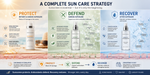
This produces a three-stage model:
1. PROTECT
Reduce UV exposure through broad-spectrum sunscreen, clothing, shade and sensible sun behaviour.
2. DEFEND
Support antioxidant systems with well-formulated complementary skincare.
3. RECOVER
Support hydration, barrier comfort and normal recovery processes after exposure.
That is a much more complete way to think about modern sun care.
Sun Protection and Skin Longevity
UV exposure is one of the most significant external influences on visible skin aging.
For that reason, photoprotection is central to skin longevity and skinspan.
But longevity-oriented skincare goes beyond preventing a single type of damage.
It considers the broader ability of skin to maintain:
-
barrier integrity
-
collagen architecture
-
oxidative balance
-
pigmentation control
-
cellular function
-
repair capacity
-
resilience
This is why sunscreen, antioxidants, hydration and cellular-support strategies can fit logically within the same longevity framework.
The Key Takeaway
Sunscreen remains the cornerstone of responsible sun care.
Nothing in an antioxidant serum, mist or after-sun treatment replaces adequate broad-spectrum UV protection.
But sunscreen does not need to stand alone.
Modern sun care can be understood as a coordinated system:
Protect → Defend → Recover
Protect the skin from excessive UV exposure.
Support antioxidant defences against environmentally generated oxidative stress.
Then support hydration, barrier comfort and the biological environment associated with normal recovery.
That is the broader opportunity in next-generation sun care.
Sunscreen prevents as much damage as possible. Intelligent skincare supports the skin around that protection.